
What is wrong with my brother / sister?
When a child’s brother or sister has cancer, it’s natural for the sibling to feel confused, scared, or even left out. They may feel resentful because of all the attention for the sick child. It is important to reassure them that these emotions are perfectly normal and maintain open and honest communication with them. It is natural for them to have many questions, and it is always better for them to hear the truth from you than listening to rumours from outside. Their age, maturity, and what they’ve observed will shape what they ask. Explain things in an honest, age-appropriate, and a reassuring way. Use clear and age-appropriate language, however, be simple, honest, and calm. For e.g., “Your brother/sister has something called cancer. That means some of the cells in their body are not working the way they should. The doctors are giving medicine to help stop those bad cells from growing.” If they are a bit older you could say, “Cancer happens when some cells grow too fast and crowd out the healthy ones. The doctors and nurses have special treatments to help stop that from happening.” Avoid making promises that the child will get better. Rather say, “The doctors are doing everything they can to help them get better.”
Younger children may not be able to talk about their fears and feelings but may express them by a change in behaviour. They may become withdrawn, revert to baby-like or childish behaviour, behave differently or become difficult, or start bed-wetting after recently being potty trained. Be gentle and loving and address this issue as soon as possible.
Some children may bottle up their feelings because they do not want to burden their parents. Some might feel guilty for being healthy or angry that life changed. When this happens, they may become withdrawn and difficult. Spend time alone with each child and encourage them to talk about their feelings. Really listen before reacting and always reassure them of your love.
Some siblings may secretly worry that they will also get cancer or if they have caused the cancer. Tell them kindly that cancer is not like catching a cold and that nothing they did or said could make this happen.
HELPFUL INFORMATION
- Keeping routines such as school, playtime, and time with friends as normal as possible. This will give them comfort and normalcy.
- Encourage them to ask questions, even about things that are scary. Wait before you answer and listen to them, even when they repeat questions.
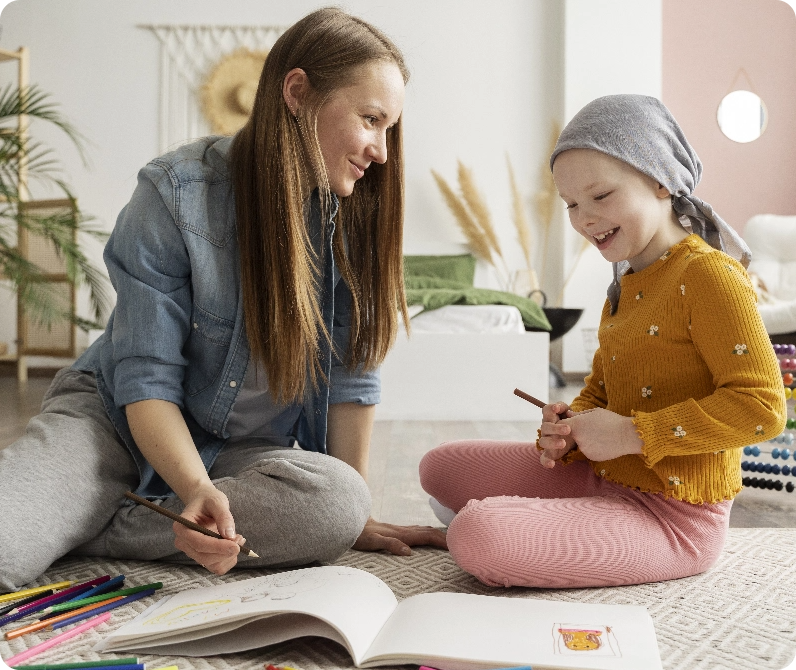
- Include them by letting them draw pictures, make cards, or visit their sibling, if appropriate.
- Give time and attention; even short, focused moments matter.
- Help them express their feelings through art, play, or talking.
- Be honest and if you don’t know an answer, it’s okay to say, “That’s a good question. I’m not sure, but we can ask the doctor or the nurse.”
READ MORE:
- Children’s Healthcare of Atlanta. (n.d.). How to Talk to Siblings of Kids with Cancer. https://www.choa.org/parent-resources/cancer/explaining-diagnosis
- American Cancer Society. (2022). Explaining cancer to children of different ages. https://www.cancer.org/cancer/caregivers/helping-children-when-a-family-member has-cancer/dealing-with-treatment/intro.html
- St Jude Children’s Research Hospital. (n.d.). Siblings of childhood cancer. https://together.stjude.org/en-us/emotional-support-daily-life/for siblings/siblings.html
- Banner Health. 2018. How to help your child cope when a sibling has cancer. https://www.bannerhealth.com/healthcareblog/advise-me/how-to-help-a-child-cope when-a-sibling-has-cancer \
- Canadian Cancer Society. (n.d.). Helping siblings cope.
https://cancer.ca/en/living-with-cancer/your-child-has-cancer/coping-with-a child-s-cancer/helping-siblings
cope#:~:text=When%20talking%20to%20siblings%20it,frightening%20for%20br others%20and%20sisters.
It is important that siblings know that nothing they did, said, or thought caused their sibling’s cancer. They need to understand that they didn’t make it happen, and they can’t make it worse. The most important thing that they can do is by being a loving brother or sister. For example: During play, or even fighting, a sibling falls and breaks a leg and shortly thereafter becomes ill and is diagnosed with cancer. The other sibling often believes that their actions, thoughts or feelings during the incident caused the cancer. This belief makes them feel guilty and responsible for their sibling’s cancer.
Parents and caregivers need to respond in a gentle way by acknowledging their feelings, “I can see you’re worried and feeling like maybe you did something to cause this. It’s really brave of you to tell me.” Reassure them that nothing they did or did not do made his or her brother sick. Listen to your child and if you pick up a misunderstanding, create a safe space and remind them gently that the illness is not their fault. It is important to address this with sensitivity and clarity. Assuring them about their vital role of play, talking and spending time with their sick sibling is invaluable to both of them and of great help in the present situation.
HELPFUL INFORMATION.
- Cancer is not anyone’s fault. Explain gently that cancer happens due to changes in cells, genes, or for other medical reasons, and nothing they did caused it, for e.g., “Sometimes our body’s cells grow in ways they aren’t supposed to. It’s nobody’s fault, not even a grown-up’s or a brother’s/sister’s.”
- Validate their feelings. Let them know it’s normal to feel scared, sad, angry, or guilty. Avoid dismissing emotions; instead, name them: “I see you feel worried and maybe even think this is your fault. That’s understandable, but it’s not true.”
- Encourage expression. Offer ways to express feelings: talking, drawing, journaling, or playing and give reassurance that sharing feelings is safe and important.
- Provide age-appropriate information. Give honest but simple explanations. Avoid overly detailed medical information for younger children. Use books or visual aids designed for siblings of children with cancer.
- Involve them in care when appropriate. Small acts, like drawing a card, reading together, or helping with practical tasks, can help them feel included without burdening them.
- Reassure them about safety and love. Emphasize that their relationship with their sibling hasn’t caused the illness. Highlight that the family still loves and needs them.
READ MORE
- Journey of a Leukaemia Warrior. 2019. Remember the siblings: Advice to effectively communicate with your healthy children about cancer.
http://www.journeyofaleukemiawarrior.com/blog/remember-the-siblings-advice-to effectively-communicate-with-your-healthy-children-about-cancer - Irish Cancer Society. (n.d.) Supporting brothers and sisters of child with cancer. A practical information guide. https://www.cancer.ie/sites/default/files/2022- 08/Supporting%20brothers%20and%20sisters%202022%20WEB.pdf
- Alex Lemonade Stand Foundation for Childhood Cancer. (n.d.). Childhood Cancer Survivors. Relationships with siblings. https://www.alexslemonade.org/childhood cancer/guides/childhood-cancer-survivors/chapter-3-relationships/relationships siblings
- Alice Prchal, et.al. 2012. How siblings of Pediatric Cancer Patients experience the first time after diagnosis. A qualitative study. Lippincott Williams & Wilkins.
https://www.researchgate.net/publication/51493836_How_Siblings_of_Pediatric_Canc er_Patients_Experience_the_First_Time_After_Diagnosis - Cancercare. (n.d.). Helping the Siblings of a Child With Cancer.
https://www.cancercare.org/publications/50-helping_the_siblings_of_a_child_with_cancer
Related Parent Carers

Informational stressors for parents (caregivers) who have a child diagnosed with cancer
A child with cancer will always have a multidisciplinary team, and within that, each discipline (like nurses, doctors, therapists) may function as intra-disciplinary sub-teams to ensure consistency.

Educating your community of family and friends
Sharing a child’s cancer journey with one’s community can raise awareness, build understanding, and gather emotional or practical support. However, it is equally important to do so in a way that protects the child’s privacy and the family’s emotional wellbeing.

Message from parents to parents
Hearing that your child has cancer is one of the most overwhelming experiences a parent can face. It often triggers a series of emotional and psychological reactions, commonly described in phases like the stages of grief, though each parent may experience them differently.