
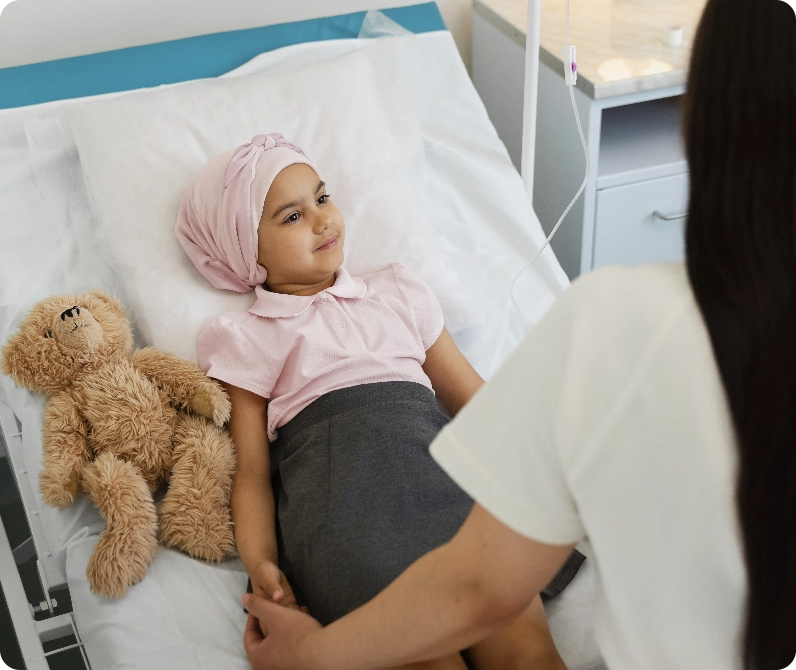
Treatment of Childhood cancer specifically aimed at parents.
Whilst cancer in children is a treatable disease and up to 70% of children can be cured, it remains a complex disease. Treating childhood cancer can be an extremely difficult and trying process, both for the child and the parents. Paediatric Oncology only uses evidence based and medically approved treatment. International tried and tested protocols are used. The introduction of multi-agent chemotherapy is called a protocol. Protocols are developed as a result of clinical trials in high income countries, leading to the best standard of care. Protocols are specific for each type of cancer
and therefore each child will be given different combinations of chemotherapy drugs. The major portion of a child's treatment will take place in a hospital.
The treatment of childhood cancers is significantly different from those in adults and requires specialist knowledge. The Paediatric Oncologist specialises in the diagnosis and treatment of children's cancers.
Each type of cancer is different and therefore treated differently. Children's cancers are treated by surgery, radiotherapy, chemotherapy, bone marrow transplant and immunotherapy. Almost all childhood cancers require chemotherapy as part of the treatment.
Cancer treatment varies because each cancer is different and parents of a child undergoing treatment are encouraged to ask their medical team for clarification of anything they do not understand.
This is the most direct way of dealing with a tumour and is the main treatment for localised (contained in one area), solid tumours. Surgery is often followed by chemotherapy and/or radiotherapy, to destroy any remaining cancer cells. Sometimes it is necessary to also remove surrounding tissue or nearby lymph nodes. Depending on the size and location of the tumour, the surgeon will try to remove the whole tumour. If an operation would be dangerous or disabling for the child, chemotherapy or radiation is given first, to shrink the tumour, and to make the surgery safer and more effective.
Tips for parents / caregivers
- Before the surgery gather clear information and prepare your child emotionally.
- Pack emotionally consolation items like the favourite blanket or a stuffed toy.
- Dress the child in loose and comfortable clothes.
- Stay calm and be present, take a deep breath and when you feel anxious, rather step away than let your child see your panic.
- Stay with your child as long as possible and keep the conversation light for e.g. talk about pets, friends and the favourite activity planned after the recovery.
- Take care of yourself. Eat something and hydrate, take short walks or practice calming techniques and if possible, have a friend to be with you.
- Stay calm during the recovery. It is normal, post anaesthesia for children to wake up groggy, upset or confused.
- Comfort them with a gentle touch and familiar voices.
- Expect your child to be more clingy for a few days and be supportive and calm.
- Celebrate your child’s bravery with a small treat or a fun activity that helps them feel proud.
Radiation is a treatment given by high energy x-rays that kill cancer cells in their path. This is also a treatment for a local, solid tumour. The number of treatments will vary depending on the diagnosis. Your doctor and the team of radiologists and radiotherapists will explain every aspect of the treatment to you in detail.
Before treatment begins, the radiologists make a careful plan of the area to be treated. Semi-permanent markings (tattoos) are then made on the skin, to mark the area that is to be radiated. To protect nearby organs and tissue, special shields or moulds are sometimes made. Radiotherapy treatment is completely painless, but the child must lie completely still to ensure the treatment is given accurately. The child must also be left alone in the treatment room for a few minutes. This can be quite frightening, especially to a young child, so it is important to explain beforehand that you will be looking at your child on a TV monitor. Try to be calm and reassure your child before the treatment. It might also help if you visit the radiation unit beforehand, so that your child can meet the therapist and have a look around. Encourage your child to keep a favourite soft toy in the room.
It is quite safe to be with your child immediately after treatment. Most children cope very well through radiotherapy, although there may be some side effects depending on the area being treated and the dose of radiation required. The treatment team will explain in detail how to handle side effects and take special care of the skin in the area that is treated, which becomes very sensitive. To protect the sensitive skin areas there are two important rules you must follow: Do not wash the skin in that area with soap and water. Do not use any skin creams or ointments, unless prescribed by the doctor.
LINAC (Linear Accelerator) machines are used to deliver external beam radiation therapy to children for various types of cancer, including brain tumours. These machines use high-energy X-rays or electrons to target and destroy cancer cells and are a common tool in paediatric oncology.
Brachytherapy can be a valuable treatment option for some paediatric cancers, particularly for localised tumours. It involves placing radioactive sources inside or near the tumour, allowing for a high dose of radiation to the targeted area while minimizing exposure to surrounding healthy tissues. This can be advantageous in reducing long-term side effects like growth retardation or the development of secondary tumours, which can sometimes occur with external beam radiation.
Tips for parents / caregivers
If possible, visit the radiation centre with your child prior to the first treatment so you and your child will know what to expect. Some centres will let the child “ride” on the table and feel the laser beams so it will not be scary.
- Review the radiation therapy plan with your doctor, including all potential side effects. Don’t be afraid to ask questions.
- Discuss what can be done to prevent or treat side effects.
- Understand the tests that will be done to monitor side effects.
- Remember that you are the expert on your child. Notify the healthcare team of any changes you notice or concerns you may have.
- To protect the sensitive skin areas there are two important rules you must follow. Do not wash the skin in that area with soap and water and do not use any skin creams or ointments, unless prescribed by the doctor.
Chemotherapy describes the drugs used in the treatment of cancer. Drugs may be given orally, intravenously, subcutaneously, intramuscularly or intrathecally (into the spinal space or subarachnoid space which contains the cerebrospinal fluid:
- Orally: Taking something "orally" means swallowing it
- Intravenous: Medicine is administered directly into the vein, usually through a needle or catheter
- Subcutaneously: Medicine is injected into the layer of fat and tissue between the skin and the muscle, where the drug can be absorbed more slowly than if injected directly into a vein or muscle.
- Intramuscularly: Medicine is administered directly into a muscle where it can be absorbed more quickly into the bloodstream.
- Intrathecally: Medicine is delivered directly into the space around the spinal cord that contains the cerebrospinal fluid via a lumbar puncture.
Chemotherapy drugs circulate through the body destroying cancer cells which are rapidly dividing. However, they also damage healthy dividing cells. Usually, chemotherapy lasts a few months. For solid tumours, after each course of drugs, lasting from one to several days, there follows a rest period of 1-4 weeks; to give the body a chance to recover from the effects the drugs have had on normal cells.
Many different chemotherapy drugs are available, but every type of cancer is treated with a specific drug or combination of drugs. The drugs used for children's cancers are the same as those used to treat cancer in adults, although given in smaller doses (since dosage is determined by the patient's body surface area, which depends on both weight and height). Chemotherapy drugs have many potential side effects, and these will be explained to you by your doctor.
Your doctor will decide on the best treatment plan (protocol) for your child's specific type of cancer after an accurate diagnosis has been made. International bodies provide guidelines and basic protocols for various cancer treatments, which are up to date with the latest findings in research and drug development.
Tips for parents / caregivers
- Listen to the medical team’s instructions and keep a written list of medications, doses, and schedules. Ask about any potential side effects and how to handle them before they happen.
- Help prevent infection. Encourage regular handwashing for everyone in the home. Avoid crowded public places or people who are sick and monitor the child’s temperature daily. Report any fever immediately to your doctor.
- The child’s taste can change during chemo. Give the child small, frequent, appealing meals and keep favourite snacks ready. Keep ice or ice water close by.
- Hydration is essential (try water, diluted juice, or clear soups).
- Manage side effects early by keeping prescribed anti-nausea medication available.
- Ask about mouth care to prevent sores - use a soft toothbrush and gently rinse the mouth.
- Use loose, comfortable clothing for sensitive skin.
- Be honest and explain the treatments to your child in child-friendly language.
- Avoid making false promises and listen to their fears.
- Maintain routines and normalcy – especially when it comes to the siblings.
- Be honest with the siblings and re-assure them that they are important and loved.
- Follow the advice of the medical team regarding visitors and outings.
- Allow people to support you and your family.
- Consider joining a parent support group – remember you are not alone.
- Apply self-care.
Bone marrow transplant (BMT) / haemopoietic stem cell transplant (HSCT)
Some children with leukaemia, certain other forms of cancer, diseases of the bone marrow that are not truly cancerous and some genetic diseases, require a bone marrow transplant as part of their treatment. This treatment option is only given to patients for whom BMT offers the best or the only chance of cure, since it is a far more intensive form of treatment than chemotherapy.
BMT is the transplanting of stem cells from the bone marrow of a healthy donor to the patient. The patient's unhealthy bone marrow cells are destroyed, and then healthy bone marrow cells are infused into the patient, almost like a blood transfusion. There are different kinds of BMT and there are many factors to consider when deciding which type of transplant should be used for a particular patient. Your doctor will discuss all of these options with you.
Types of bone marrow transplant include:
- AUTOLOGOUS TRANSPLANT: The child's own bone marrow is used. Bone marrow is taken from the patient, stored in a special freezer and given back to the patient at a later stage.
- ALLOGENIC TRANSPLANT: A family member or another unrelated person donates bone marrow to the child.
- SYNGENIC TRANSPLANT: The child's identical twin is the donor.
- STEM CELL TRANSPLANT: Stem cells from the circulating blood in the body or from a placenta (after birth) can be used instead of bone marrow.
The first step in preparing for BMT is to destroy the patient's unhealthy bone marrow. This is done by giving the patient high-dose chemotherapy and sometimes a form of radiation therapy called Total Body Irradiation. The purpose of this is to kill all the cancer cells in the body and the abnormal parts of the bone marrow. However, this treatment also destroys the white blood cells that protect the body against infections, making the patient very susceptible to all kinds of infection. It can take 6 to 12 months after the transplant before the patient's immune system recovers. BMT is really intensive and tough on the patient's body and requires a stay in hospital for 6 weeks or longer.
Tips for parents / caregivers
- Understand the process and keep a diary to monitor progress and concerns and a file with all the relevant documents.
- Understanding them helps you make informed decisions.
- Follow infection-control rules religiously - hand hygiene is non-negotiable.
- Adhere to the hospital’s requirements when it comes to visitors.
- Adhere to the child’s diet as advised by the dietician.
- Give the child a sense of independence by allowing them to choose small things like what clothes they wear, which book to read, or which movie to watch.
- Open, honest, gentle and clear communication to the child and family is paramount. Explain what’s happening at their level of understanding.
- Make the hospital room child-friendly and less sterile. Bring favourite things from home and bring normalcy to the abnormal environment, keep your daily routine and bring fun and entertainment to the room.
- Mouth sores are common — follow the mouthrinse / care protocol exactly.
- Keep skin moisturized and watch for rashes — these could be early signs of graft-versus-host disease (a complication of donated stem cell transplants).
- Take care of yourself. Allow other caregivers to give you off-time and allow your community to support your family at home.
- Connect with a parent support group and reach out to allied medical professionals for help and guidance.
- Post-transplant precautions can last 6–12 months: avoiding crowds, wearing masks, limiting school attendance until immune function recovers.
- Ask the medical team for advice about vaccinations.
- Monitor for late effects: Growth, hormone function, learning, and emotional wellbeing may need ongoing assessment.
The body's immune system is made up of white blood cells called lymphocytes. These circulate through the body to protect it and fight against infections. There are two types of cells that work together to protect the body against viral infection:
- B-lymphocytes produce antibodies which bind to a virus, thereby preventing it from infecting healthy cells;
- T-lymphocytes (cytotoxic T-cells) destroy infected cells.
Patients who have had a bone marrow transplant do not have enough T-cells. It is possible to take T-cells from a bone marrow donor and give these to the patient. However, this can cause the patient's body to reject the donor marrow because the foreign T-cells ‘attack’ the patient's body. Scientists are now testing ways to give T-cells to a patient without causing this attack and rejection reaction. They are also looking into the possibility of the patient's own immune system fighting the tumour cells. Some tumours are caused by viral infections and in this case the T-cells must be able to recognise and kill the tumour cells.
In other words: Tumour cells often produce abnormal proteins (tumour antigens) that are not found on normal cells. Cytotoxic T-cells can recognize these antigens when they are presented on the surface of tumour cells. Once a T-cell recognizes a tumour antigen, it can become activated. Activated cytotoxic T-cells can kill the tumour cell. Over time, a strong T-cell response can shrink or eliminate a tumour.
Tips for parents / caregivers
Immunotherapy can be powerful but comes with unique side effects and uncertainties. Careful monitoring, open communication with the care team, and strong emotional support for both your child and you make the journey easier. It is important to understand the treatment. Immunotherapy works by boosting the child’s immune system to fight cancer. Different types exist (e.g., monoclonal antibodies, checkpoint inhibitors, CAR-T cell therapy), each with unique side effects. These are new and unknown terms, and you as the parent may ask questions and expect clear explanations from the medical staff about what to expect before, during, and after treatment.
- Keep track of the side effects by keeping a journal. Diarise any changes such as fever, a rash, fatigue, mood shifts, breathing issues, or new pains and discuss this with the medical team.
- Report high fever, breathing difficulty, confusion, or severe allergic reactions immediately to the medical team and ask for guidance.
- Be consistent with appointments and medication instructions. Immunotherapy often requires strict treatment timing.
- Prepare your child: Explain in age-appropriate ways what the treatment does and why it’s important.
- Provide a favourite toy, book, music, or a blanket to help them feel safe, distracted and comforted.
- Many children tire easily; allow rest breaks and don’t push too hard with activities.
- Provide reassurance, maintain routines, and consider child-friendly counselling or support groups.
- Prevent infections by good handwashing, avoiding contact with sick people, and keeping the environment clean and hygienic.
- Encourage healthy, balanced meals and fluids; especially water. Some children may have appetite loss or taste changes.
- Caring for a child with cancer is exhausting—make sure you as the parent or caregiver eat, rest, and accept help from friends or family.
- Join parent support groups (in person or online) to share experiences with families going through immunotherapy.
- Stay informed but balanced: Use reliable sources (hospital handouts, paediatric oncology organizations) instead of overwhelming internet searches.
Related Parent Carers

Informational stressors for parents (caregivers) who have a child diagnosed with cancer
A child with cancer will always have a multidisciplinary team, and within that, each discipline (like nurses, doctors, therapists) may function as intra-disciplinary sub-teams to ensure consistency.

Educating your community of family and friends
Sharing a child’s cancer journey with one’s community can raise awareness, build understanding, and gather emotional or practical support. However, it is equally important to do so in a way that protects the child’s privacy and the family’s emotional wellbeing.

Message from parents to parents
Hearing that your child has cancer is one of the most overwhelming experiences a parent can face. It often triggers a series of emotional and psychological reactions, commonly described in phases like the stages of grief, though each parent may experience them differently.